



2 min read
Greater Transparency and Efficiency in IT Service Management
DEMICON
:
Jul 9, 2026, 2:08:37 PM
No unified SLAs, no tool support, no governance: an international industrial group professionalizes its IT service management, achieving 30–40% shorter processing times and significantly higher customer satisfaction.
IT Service Level Transformation –
From a lack of transparency to controllable service quality in IT service management!
As part of the project, an internationally active industrial company with more than 6,000 employees across more than 100 locations in over 40 countries professionalised its IT service management. This was set against the backdrop of a comprehensive realignment of the IT organisation's Target Operating Model.
Challenge
- No transparency on response and resolution times: service quality could neither be objectively assessed nor specifically improved
- No unified, market-appropriate SLA/OLA standards
- ITSM processes with no tool support; communication conducted exclusively via email
- Unclear responsibilities between the ITSM teams
- Service descriptions only partially available, technically framed, and barely comprehensible to end users
Holistic Solution: Four-Stage Approach Model
From developing the target vision to company-wide rollout: a deliberately chosen pilot area (IT Workplace) validated the approach before it was scaled to other IT areas.

![]()
- Target vision & analysis: Together with the IT steering committee, the target vision for the ITSM organisation was developed. The existing service landscape was systematically captured and benchmarked against market standards, with a focus on service offerings, customers, responsibilities, reporting, and processes.
- Solution concept: Together with the core team, service offerings and the associated SLAs and OLAs were defined. Key element: concrete response and resolution times per task that are acceptable from the customer's perspective, derived from internal OLAs per service action.
- Implementation: Final alignment of SLAs and OLAs with the responsible business units and IT management, company-wide communication of the binding target figures, and establishment of SLA reporting for ongoing governance.
- Company-wide rollout: Transfer of the approach to further IT areas (e.g., Security), along with support for cross-functional IT governance via the established SLA reporting.
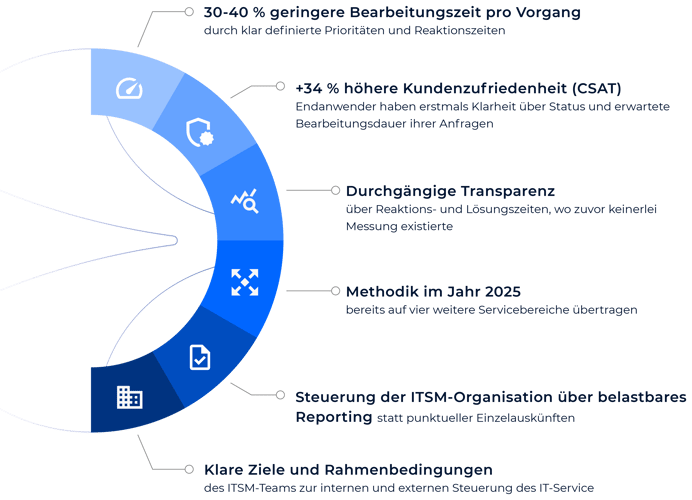
Benefits for the Customer
![]()
Implementation took place in close workshop formats, directly with IT leadership and the internal ITSM team. Thanks to the iterative approach across the four project phases, the methodology was continuously adapted to the real service landscape before being scaled to further areas.
Outlook
The methodology developed in the pilot area has proven practical and has long since grown beyond its original use case: four additional service areas, including IT Security, were professionalized following the same approach. Going forward, further automation of SLA reporting is planned, as well as the introduction of a coordinated penalty concept for non-compliance with SLAs and OLAs.

More transparency and control in IT service management?
Our Business Consulting experts support you from developing the target vision through to rollout.
Hubertus Schmidt
COO / Head of Consulting
Do you have any questions or would like personal consultation? Our expert will be happy to assist you.
Get in touch now!
IT-Transformation: New Dimensions in Service Management
Challenges and Objectives