From Excel to a –
Harmonised Capacity Planning Process!
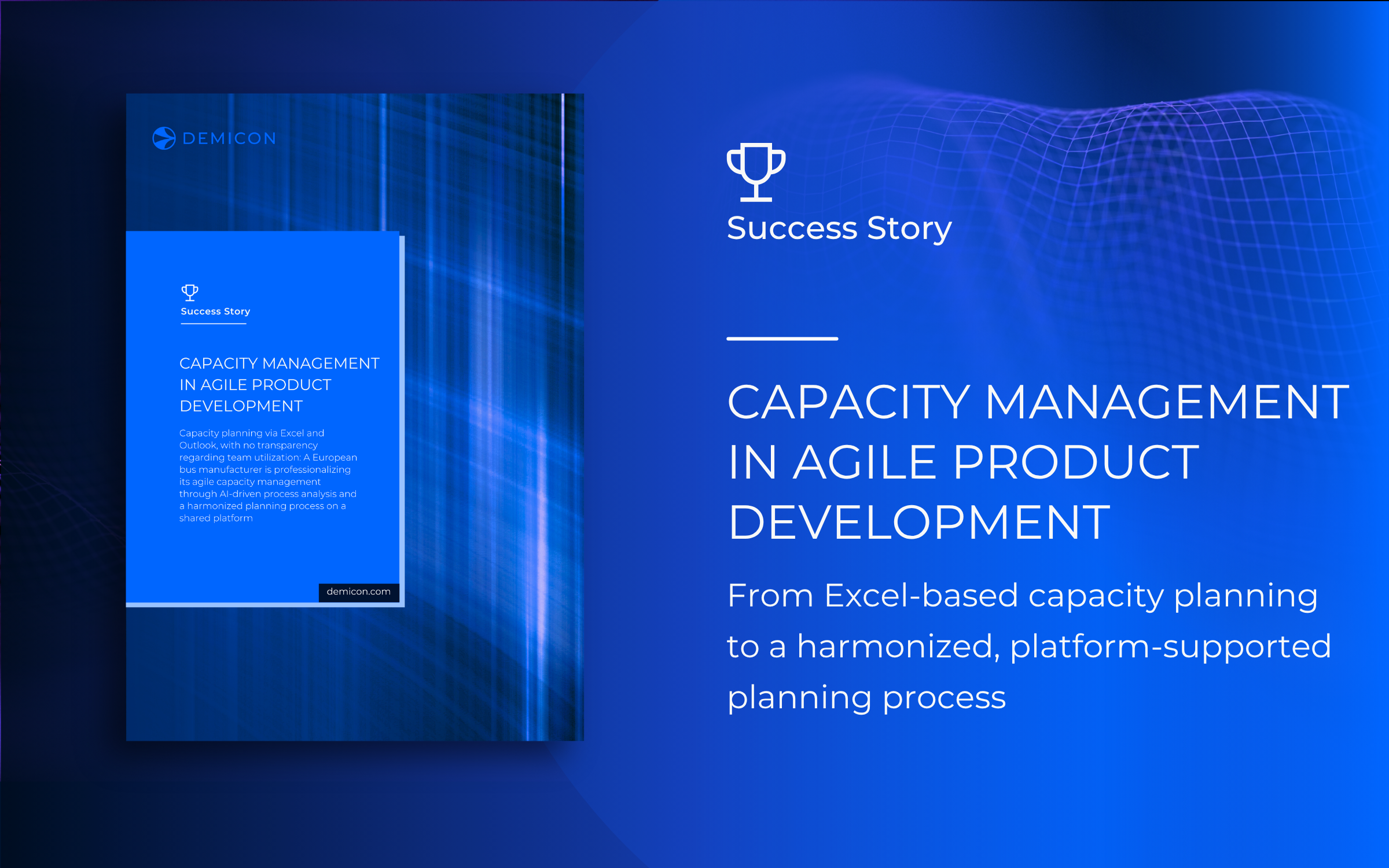
A leading European bus manufacturer, part of a global commercial vehicle group, wanted to professionalise its capacity management from both a process and technology perspective. Its product development organisation operates at scale using the SAFe framework, with multiple Agile Release Trains (ARTs) and numerous teams planning their work across Program Increments (PIs) and iterations. Until then, capacity planning had been managed independently by individual teams using Excel and Outlook, resulting in significant manual effort and no consistent planning process.
Challenges
- Decentralised capacity planning based on Excel spreadsheets and Outlook, requiring substantial manual effort for data collection, consolidation and coordination.
- Each team followed its own planning approach. Over time, isolated solutions with varying levels of maturity had evolved, with no standardised or documented capacity planning process.
- Limited visibility into the actual utilisation of teams and Agile Release Trains across Program Increments and iterations. Capacity bottlenecks often became apparent too late-or not at all.
- No single source of truth. Planning data was distributed across different teams and roles, making it impossible to obtain an aggregated management view.
- Different iteration cycles between teams, combined with unclear handling of external supplier work items, made it difficult to gain an ART-wide perspective.
- High coordination effort. Alignment across six Release Train Engineers (RTEs) relied on manual communication without a central process or shared planning tool.
The Solution: A Four-Phase Delivery Approach
Rather than digitising existing inefficiencies, the project began by understanding and optimising the underlying process before implementing a technical solution. The customer was supported through four structured phases, starting with a Proof of Concept to validate the approach before deploying the solution on the organisation's existing cplace platform.

- Proof of Concept & Validation: Interactive dashboards were rapidly prototyped within the customer's cplace development environment, including a Team Analytics Dashboard and an ART overview with utilisation heat maps by team, Program Increment and iteration (Planned vs Available Effort and remaining PI capacity). Several feedback cycles with RTEs and development teams refined the Proof of Concept and secured stakeholder buy-in.
- AI-Powered Process Analysis (Current State Assessment): Instead of running months of workshops, structured interviews were conducted with teams and stakeholders and analysed alongside the existing Excel planning artefacts. A dedicated AI workflow automated much of the analysis by:
- Cleaning interview transcripts, including resolving domain-specific acronyms and correcting transcription errors.
- Producing structured summaries based on predefined key questions, such as "How are work items created?" and "How is team capacity determined?". This enabled direct comparison of planning processes across all teams.
- Automatically generating BPMN process models (Camunda) for each existing process, which were subsequently refined by the consulting team.
- Process Optimisation & Target Operating Model: Comparing the documented current-state processes revealed common patterns, gaps and best practices. One team had already established a particularly mature internal capacity planning process, and its successful approaches were incorporated into the future operating model. The result was a harmonised, cross-team planning process with: clearly defined responsibilities, consistent planning logic across all iteration cycles, transparent handling of external supplier work, and minimal manual effort for individual teams. The target process was developed collaboratively through on-site kick-off workshops, regular review sessions and the early involvement of the Works Council to ensure organisational acceptance.
- Implementation on the Existing Enterprise Platform: The optimised target process is now being implemented directly on the customer's existing cplace platform, eliminating the need for an additional standalone solution. To further improve usability and minimise user interaction, the customer also invested in the cplace Widget Builder (AI Premium package).
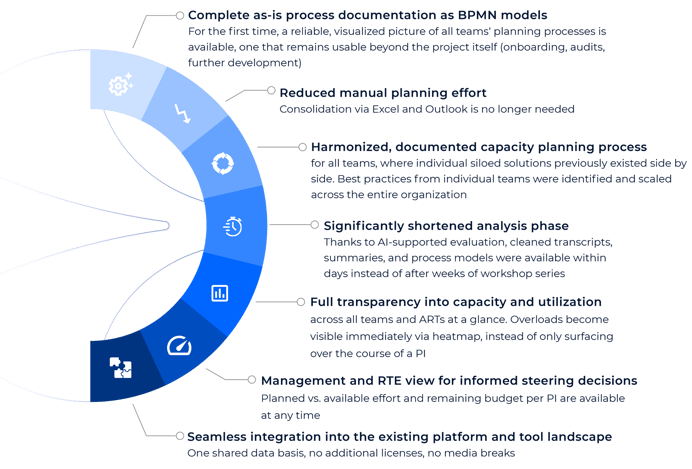
Benefits for the Customer
Outlook
Following successful validation through the Proof of Concept, the solution is currently being rolled out across the customer's platform.
The newly available Widget Builder will further enhance the user experience, with the objective of enabling end-to-end capacity planning from a single page with minimal user interaction.
Future enhancements include integration with Jira for the automatic synchronisation of work items, as well as extending the AI-driven process analysis and optimisation approach to additional business areas across the organisation.










 DEMICON

 DEMICON : Nov 6, 2025, 3:58:05 PM